
Community Invited to Walk for a Good Cause
Walking The Talk Foundation is inviting the community to join us for a 5km fundraising walk at Ruimsig Stadium. The event will take place on Sunday, 1 November 2026, starting

We Put VR in Four Schools. Now imagine 100.
Last year at Merlewood Secondary School in Port Shepstone, something remarkable happened.
A learner who had always struggled with science put on a VR headset and stepped inside the human heart. She followed blood cells through arteries. She watched valves open and close. She didn’t just read about biology — she experienced it.
For the first time, she wasn’t trying to catch up.
She was leading the discussion.
That moment wasn’t luck. It was the result of deliberate partnership and execution.
Through a collaboration between Walking The Talk Foundation, Ulink2All and Durban Preparatory High School, Merlewood received:
Across KwaZulu-Natal, similar momentum has taken root:
Four schools. Hundreds of learners.
One clear outcome: this works.
Now we scale.
South Africa’s digital divide is not static. It is widening.
In well-resourced schools, learners are:
In under-resourced schools, learners are:
Every year we delay, the gap deepens.
The solution is not theory. It is implementation at scale.
We did not start with a promise to change everything overnight.
We started with a practical model:
Identify schools with committed leadership
Deliver reliable, curriculum-aligned technology
Train educators thoroughly
Deliver reliable, curriculum-aligned technology
Measure engagement and adoption
Phase 1 validated the model.
We now have:
The foundation is stable.
The next step is expanding to 20 additional schools across South Africa.
Projected Impact:
This is not experimental. It is expansion.
We have:
What we require now is funding to execute.
At 100 schools, this becomes more than a programme.
It becomes systemic change.
Imagine:
One hundred schools represent tens of thousands of digitally literate learners over time.
That is not a donation.
That is economic infrastructure.
A digitally literate young South African today is:
Educational technology, when properly deployed, does more than improve engagement. It strengthens:
This is education aligned with economic development.
Scaling requires clear funding architecture.
A fully equipped school solution includes:
Funding partners receive:
This is not logo placement.
This is a strategic partnership.
At Merlewood, something else happened beyond improved engagement.
Learners went home and spoke about what they experienced.
Parents asked questions.
Siblings became curious.
Curiosity spreads.
A learner who experiences possibility begins to think differently about their future.
That shift influences subject choices, tertiary applications, and career ambition.
Multiply that by 20 schools.
Multiply that by 100 schools.
You do not simply change test performance.
You alter trajectories.
We are not asking you to fund devices.
We are asking you to accelerate systemic digital access across our country.
The operational model exists.
The schools are ready.
The suppliers are aligned.
The missing variable is funding velocity.
Because delay compounds inequality.
Because digital literacy compounds opportunity.
Because small pilots prove potential — but scale creates change.
Four schools proved the model.
Twenty schools strengthen the region.
One hundred schools transform it.
The learner who stepped inside the human heart at Merlewood is still learning. Still discovering. Still expanding her understanding of what is possible.
She represents what happens when access meets opportunity.
Phase 1 is complete.
Phase 2 is ready.
Phase 3 is achievable.
The only question is speed.
Will we scale cautiously — or decisively?
With the right partners, twenty schools become immediate.
With sustained commitment, one hundred schools becomes inevitable.
This is not a future concept.
It is a proven model awaiting acceleration.
Because access changes classrooms.
Classrooms change futures.
And futures shape economies.
Walking The Talk Foundation is inviting the community to join us for a 5km fundraising walk at Ruimsig Stadium. The event will take place on Sunday, 1 November 2026, starting
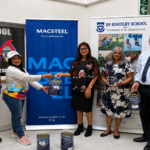
At Walking the Talk Foundation, we believe lasting change begins when communities work together. This Mandela Day, we partnered with Macsteel, ONOMO Hotel, and dedicated volunteers to uplift Isipingo Hills

We Put VR in Four Schools. Now imagine 100. Phase 1: Proven.Phase 2: Funded.Phase 3: A generation changed. Last year at Merlewood Secondary School in Port Shepstone, something remarkable happened.